- 1. Getting Started
-
2.
First Semester Topics
-
General Chemistry Review
- Introduction
- Electron Configurations of Atoms
- QM Description of Orbitals
- Practice Time - Electron Configurations
- Periodic Trends
- Hybridization
- Closer Look at Hybridization
- Strategy to Determine Hybridization
- Practice Time! - Hybridization
- Formal Charge
- Practice Time - Formal Charge
- Acids-bases
- Practice Time - Acids and Bases
- Hydrogen Bonding is a Verb!
- Electronegativity: The Key to Reactivity
- ESP Maps and Molecular Polarity
-
Structure and Bonding
- Chemical Intuition
- From Quantum Mechanics to the Blackboard: The Power of Approximations
- Atomic Orbitals
- Electron Configurations of Atoms
- Electron Configurations Tutorial
- Practice Time - Structure and Bonding 1
- Lewis Structures
- Drawing Lewis Structures
- Valence Bond Theory
- Valence Bond Theory Tutorial
- Hybridization
- Polar Covalent Bonds
- Formal Charge
- Practice Time - Structure and Bonding 2
- Curved Arrow Notation
- Resonance
- Electrons behave like waves
- MO Theory Intro
- Structural Representations
-
Acids/Base and Reactions
- Reactions
- Reaction Arrows: What do they mean?
- Thermodynamics of Reactions
- Acids Intro
- Practice Time! Generating a conjugate base.
- Lewis Acids and Bases
- pKa Scale
- Practice Time! pKa's
- Predicting Acid-Base Reactions from pKa
- Structure and Acidity
- Structure and Acidity II
- Practice Time! Structure and Acidity
- Curved Arrows and Reactions
- Nucleophiles
- Electrophiles
- Practice Time! Identifying Nucleophiles and Electrophiles
- Mechanisms and Arrow Pushing
- Practice Time! Mechanisms and Reactions
- Energy Diagrams and Reactions
- Practice Time! - Energy Diagrams
- Introduction to Retrosynthesis
-
Alkanes and Cycloalkanes
- Introduction to Hydrocarbons and Alkanes
- Occurrence
- Functional Groups
- Practice Time! Functional Groups.
- Structure of Alkanes - Structure of Methane
- Structure of Alkanes - Structure of Ethane
- Naming Alkanes
- Practice Time! Naming Alkanes
- Alkane Isomers
- Relative Stability of Acyclic Alkanes
- Physical Properties of Alkanes
- Ranking Boiling Point and Solubility of Compounds
- Conformations of Acyclic Alkanes
- Practice Time! Conformations of acyclic alkanes.
- Conformations of Cyclic Alkanes
- Naming Bicyclic Compounds
- Stability of Cycloalkane (Combustion Analysis)
- Degree of Unsaturation
- Alkane Isomers
-
Stereochemistry
- Enalapril in ACE
- Constitutional and Stereoisomers
- Chirality or Handedness
- Drawing a Molecules Mirror Image
- Exploring Mirror Image Structures
- Enantiomers
- Drawing Enantiomers
- Practice Time! Drawing Enantiomers
- Identifying Chiral Centers
- Practice Time! Identifying Chiral Molecules
- CIP (Cahn-Ingold-Prelog) Priorities
- Determining R/S Configuration
- Diastereomers
- Meso Compounds
- Fischer Projections
- Fischer Projections: Carbohydrates
- Measuring Chiral Purity
- Practice Time! - Determining Chiral Purity and ee
- Chirality and Drugs
- Chiral Synthesis
- Prochirality
- Converting Fischer Projections to Zig-zag Structures
- Practice Time! - Assigning R/S Configurations
-
Alkenes and Addition Reactions
- The Structure of Alkenes
- Alkene Structure - Ethene
- Physical Properties of Alkenes
- Naming Alkenes
- Health Insight - BVO (Brominated Vegetable Oil)
- E/Z and CIP
- Stability of Alkenes
- H-X Addition to Alkenes: Hydrohalogenation
- Practice Time - Hydrohalogenation
- X2 Addition to Alkenes: Halogenation
- HOX addition: Halohydrins
- Practice Time - Halogenation
- Hydroboration/Oxidation of Alkenes: Hydration
- Practice Time - Hydroboration-Oxidation
- Oxymercuration-Reduction: Hydration
- Practice Time - Oxymercuration/Reduction
- Oxidation and Reduction in Organic Chemistry
- Calculating Oxidation States of Carbon
- Identifying oxidation and reduction reactions
- Practice Time - Oxidation and Reduction in Organic
- Oxidation
- Reduction
- Capsaicin
-
Alkynes
- Structure of Ethyne (Acetylene)
- Naming Alkynes
- Practice Time! - Naming Alkynes
- Physical Properties of Alkynes
- Preparation of Alkynes
- Practice Time! - Preparation of Alkynes
- H-X Addition to Alkynes
- X2 Addition
- Hydration
- Reduction of Alkynes
- Practice Time! - Addition Reactions of Alkynes
- Oxidative Cleavage of Alkynes
- Alkyne Acidity and Acetylide Anions
- Reactions of Acetylide Anions
- Retrosynthesis Revisted
- Practice Time! - Multistep Synthesis Using Acetylides
-
Alkyl Halides and Alcohol
- Naming Alkyl Halides
- Naming Alcohols
- Classes of Alcohols and Alkyl Halides
- Practice Time! - Naming Alkyl Halides
- Practice Time! - Naming Alcohols
- Physical Properties of Alcohols and Alkyl Halides
- Structure and Reactivity of Alcohols
- Structure and Reactivity of Alkyl Halides
- Preparation of Alkyl Halides and Tosylates from Alcohols
- Practice Time! - Alcohols to Alkyl Halides
- Preparation of Alkyl Halides from Alkenes; Allylic Bromination
- Strategy for Predicting Products of Allylic Brominations
- Practice Time! - Allylic Bromination
-
Substitutions (SN1/SN2) and Eliminations (E1/E2)
- Introduction
- Solvents
- SN1 Reaction: The Carbocation Pathway
- SN2 Reactions: The Concerted Backside Attack
- SN1 vs. SN2: Choosing the Right Path
- Application: Cardura (Doxazosin)
- E1 Reactions: Elimination via Carbocations
- E2 Reactions: The Concerted Elimination
- E1cB: The Conjugate Base Elimination Pathway
- Substitution versus Elimination
-
Dienes, Allylic and Benzylic systems
- Allyl Cations, Anions and Radicals
- Allyl and Vinyl Groups
- Allylic Halogenation
- SN1 and SN2 Reactions of Allylic Halides and Tosylates
- Diels Alder Reaction
- Electrophilic Addition - 1,2 versus 1,4
- π-Molecular Orbitals and Conjugation
- Kinetic versus Thermodynamic Control: HBr Addition to 1,3-Butadiene
- Naming Polyenes
-
General Chemistry Review
-
3.
Second Semester Topics
- Arenes and Aromaticity
-
Reactions of Arenes
- Electrophilic Aromatic Substitution
- EAS-Halogenation
- EAS-Nitration
- Practice Time - Synthesis of Aniline
- EAS-Alkylation
- Practice Time - Friedel Crafts Alkylation
- EAS-Acylation
- Practice Time - Synthesis of Alkyl Arenes
- EAS-Sulfonation
- Practice Time - EAS
- Donation and Withdrawal of Electrons
- Regiochemistry in EAS
- Practice Time - Directing Group Effects
- Synthesizing Disubstituted Benzenes: Effects of Substituents on Rate and Orientation
- Steric Considerations
- Strategies for Synthesizing Disubstituted Benzenes
- NAS - Addition/Elimination
- NAS - Elimination/Addition - Benzyne
- Alcohols and Phenols
-
Ethers and Epoxides
- Intro and Occurrence
- Crown Ethers and Cryptands
- Preparation of Ethers
- Reactions of Ethers
- Practice Time - Ethers
- Preparation of Epoxides
- Reactions of Epoxides - Acidic Ring Opening
- Practice Time - Acidic Ring Opening
- Reactions of Epoxides - Nucleophilic Ring Opening
- Practice Time - Nucleophilic Ring opening
- Application - Epoxidation in Reboxetine Synthesis
- Application - Nucleophilic Epoxide Ring Opening in Crixivan Synthesis
- Physical Properties of Ethers and Epoxides
- Naming Ethers and Epoxides
-
Aldehydes and Ketones
- Naming Aldehydes and Ketones
- Physical Properties of Ketones and Aldehydes
- Practice Time - Naming Aldehydes/Ketones
- Nucleophilic addition
- Addition of Water - Gem Diols
- Practice Time - Hydration of Ketones and Aldehydes
- Addition of Alcohols - Hemiacetals and Acetals
- Acetal Protecting Groups
- Hemiacetals in Carbohydrates
- Practice Time - Hemiacetals and Acetals
- Addition of Amines - Imines
- Addition of Amines - Enamines
- Practice Time - Imines and Enamines
- Application - Imatinab Enamine Synthesis
- Addition of CN - Cyanohydrins
- Practice Time - Cyanohydrins
- Application - Isentress Synthesis
- Addition of Ylides - Wittig Reaction
- Practice Time - Wittig Olefination
- Structure of Ketones and Aldehydes
- Carboxylic Acids and Derivatives
- Enols and Enolates
- Condensation Reactions
-
4.
NMR, IR, UV and MS
- Spectroscopy
-
HNMR
- Nuclear Spin
- Interpreting
- Chemical Shift
- Practice Time! - Chemical Shift
- Equivalency
- Indentifying Homotopic, Enantiotopic and Diastereotopic Protons
- Practice Time! - Equivalency
- Intensity of Signals
- Spin Spin Splitting
- Practice Time! - Spin-Spin Splitting
- Primer on ¹³C NMR Spectroscopy
- Alkanes
- Alkynes
- Alcohols
- Alkenes
- Coupling in Cis/Trans Alkenes
- Ketones
- HNMR Practice 1
- HNMR Practice 2
- HNMR Practice 3
- HNMR Practice 4
- Exchangeable Protons and Deuterium Exchange
- IR - Infrared Spectroscopy
- UV - Ultraviolet Spectroscopy
- Mass Spectrometry
-
5.
Tools and Reference
- 2D Editor
- 3D Model Kit
- Molar Mass Calculator
- Newman Projection Tool
- Fischer to Zigzag
- Chromatograph Simulator
- TLC Simulator
- Periodic Table
- Sig Fig Calculator
- Degree of Unsaturation Calculator
- Chemical Reaction Kinetic Simulator
-
Reagents
- Named Reactions
- pKa Values
- Heterocycles
- Bond Dissociation Energies
- 6. Tutorials
-
7.
The Alchemy of Drug Development
- Ivermectin: From Merck Innovation to Global Health Impact
- The Fen-Phen Fix: A Weight Loss Dream Turned Heartbreak
- The Asymmetry of Harm: Thalidomide and the Power of Molecular Shape
- Semaglutide (Ozempic): From Lizard Spit to a Once-Weekly Wonder
- From Cocaine to Novocain: The Development of Safer Local Anesthesia
- The Crixivan Saga: A Targeted Strike Against HIV
- The story of Merck’s COX-2 inhibitor, Vioxx (rofecoxib)
- The Accidental Aphrodisiac: The Story of Viagra
- THC: A Double-Edged Sword with Potential Neuroprotective Properties?
- Ritonavir Near Disaster and Polymorphism
Clear History
Writing and Balancing Chemical Equations
Writing and Balancing Chemical Equations
- A reaction equation can describe both physical and chemical changes.
- The starting materials (reactants) are on the left while the final products are on the right.
- The following combustion reaction can be verbally stated as follows.
Chemical Equation for Physical Change
An example of a chemical reaction showing a physical change is as folllows, which represents the melting of Ice (i.e. water in the solid state) to liquid water.
H2O(s) ➞ H2O(l)
In this equation, the (s) indicates the water is in the gas phase and (l) is for the liquid phase. We will also encounter (s) to indicaste solids and (aq) to represent aqueous solutions.
Chemical equations for Chemical Change
An example of a chemcial reaction for a chemical change is the combustion of methane (CH4).
CH4 + 2O2 ➞ CO2 + 2H2O
Verbally we would say "One molecule (or mole) of CH4 reacts with 2 molecules (or moles) of O2 to produce one molecule (or mole) of CO2 and two molecules of H2O (water)".
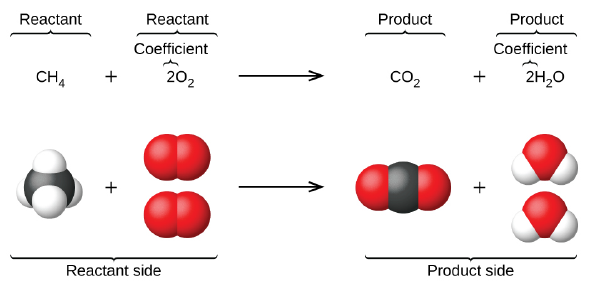
The ratios expressed for this particular reaction hold true no matter how many moles one startes with … if you double the moles of 1 component, all other must be doubled to hold true.
The fixed ratio of this particular reaction allows us to predict how many moles (and by extension, grams) of product we could make if we start with a specific mass (or moles) of a reactant.
Balanced Chemical Reactions
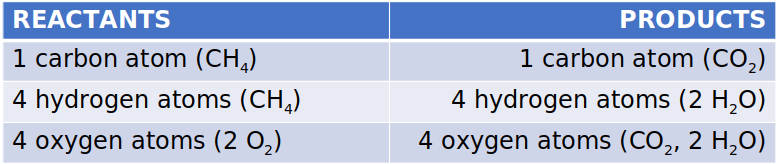
The following reaction is balanced.
CH4 + O2 ➞ CO2 + H2O
This means that the numbers and types of elements on the left are equal to the numbers and types of elements on the right. This must always be true to obey the Conservation of Mass.
Unbalanced Chemical Reactions
The following chemical reaction is unbalanced. This reaction represents the electrolysis (i.e. using electricity to split a water molecule in to hydrogen (H2) and oxygen (O2)).
2H2O ➞ O2 + H2

Your goal is to balance this equation so equal numbers of each atom are on each side.
Problem: Balance the equation for the combustion of ethanol (alcohol) in the body:
H2O ➞ H2 + O2
- Hydrogen: 2 on left, 2 on right.
- Oxygen: 1 on left, 2 on right. Put a "2" in front of H2O.
- 2H2O ➞ H2 + O2
- Do it again.
- Hydrogen: 4 on left, 2 on right. Put a "2" in front of the O2.
Sometimes, it may be easier to use a temporary fraction in the balancing process. If we burn butane in oxygen, we create water and carbon dioxide (same with any hydrocarbon fuel).
C4H10 + O2 ➞ CO2 + H2OWe can balance the carbons and hydrogens first easily on the right, since they’re in separate compounds.
C4H10 + O2 ➞ 4 CO2 + 5 H2O - 2H2O ➞ 2H2 + O2
Is the following balanced? Na(s) + H2O(l) ➞ NaOH(aq) + H2(g) No.
While Na and O are equal on both sides, there are 2 H on the left and 3 H on the right.
What do we do? Hint: Easiest to create even numbers of atoms. Na(s) + H2O(l) ➞ 2 NaOH(aq) + H2(g)
Since NaOH has all three element types, making them even in number (2) allows us to alter the other compounds more easily.
2 Na(s) + 2 H2O(l) ➞ 2 NaOH(aq) + H2(g)
How to Balance: The Trial-and-Error Method
This technique is know as the "Trial and Error" method.
1. Write the correct formulas for reactants and products.
2. Count the atoms of each element on both sides.
3. Use coefficients to balance elements one at a time. Tip: Leave Oxygen and Hydrogen for last.
Problem: Balance the equation for the combustion of ethanol (alcohol) in the body:
C2H5OH + O2 ➞ CO2 + H2O
Click for Step-by-Step Logic- Carbon: 2 on left, 1 on right. Put a "2" in front of CO2.
- Hydrogen: 6 on left (5+1), 2 on right. Put a "3" in front of H2O.
- Oxygen: Now you have (2*2) + 3 = 7 on the right. On the left, you have 1 (in ethanol). You need 6 more. Put a "3" in front of O2.
- Final Result: C2H5OH + 3O2 ➞ 2CO2 + 3H2O
Example Problem 1
Is the following balanced?
Na(s) + H2O(l) ➞ NaOH(aq) + H2(g)
No. While Na and O are equal on both sides, there are 2 H on the left and 3 H on the right. What do we do? Hint: Easiest to create even numbers of atoms.
Na(s) + H2O(l) ➞ 2 NaOH(aq) + H2(g)
Since NaOH has all three element types, making them even in number (2) allows us to alter the other compounds more easily.
2 Na(s) + 2 H2O(l) ➞ 2 NaOH(aq) + H2(g)

Example Problem 2
Is the following equation balanced?
NH4NO3 ➞ N2 + O2 + H2O
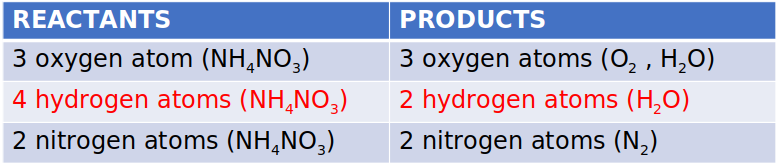
Let’s double the H2O
NH4NO3 ➞ N2 + O2 + 2 H2O
Now there are 3 O on left, 4 on the right. Since the left is odd, let’s double the reactant.
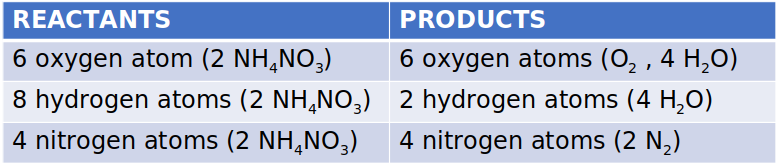
2 NH4NO3 ➞ N2 + O2 + 2 H2O
Now there are 6 O, 4 N, and 8 H on the left; 4 O, 2 N, and 4 H on the right. At least they’re all even. First, let’s fix nitrogen…
2 NH4NO3 ➞ 2 N2 + O2 + 2 H2O
Now we have 6 O, 4 N, and 8 H on the left; 4 O, 4 N, and 4 H on the right.
We need two more O on the right and twice the number of H on the right. Let’s alter H2O again, since it has both elements in it:
2 NH4NO3 ➞ 2 N2 + O2 + 4 H2O
Example Problem 3
Sometimes, it may be easier to use a temporary fraction in the balancing process. If we burn butane in oxygen, we create water and carbon dioxide (same with any hydrocarbon fuel).
C4H10 + O2 ➞ CO2 + H2O
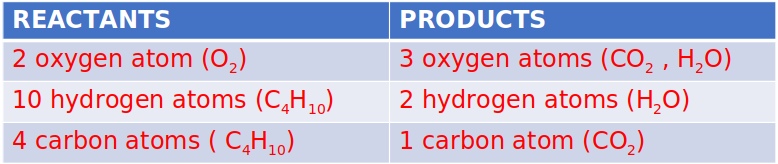
We can balance the carbons and hydrogens first easily on the right, since they’re in separate compounds.
C4H10 + O2 ➞ 4 CO2 + 5 H2O
Now carbons (4) and hydrogens (10) are balanced. What about oxygen?
Since oxygen stands alone in O2, but we have an even and odd number in CO2 and H2O, let’s use a temporary fraction.
C4H10 + O2 ➞ 4 CO2 + 5 H2O

Since we need 13 O atoms (those on the right) but we have O2, by multiplying by 13/2 … we get 13 O atoms on the left.
C4H10 + 13/2 O2 ➞ 4 CO2 + 5 H2O
It’s now balanced but we don’t like fractions in our equations. Since this is balanced, we can multiply everything by ‘2’ to get rid of the fraction:
2 C4H10 + 13 O2 ➞ 8 CO2 + 10 H2O

Example Problem 4
When balancing reactions that contain polyatomic ions, we can often (not always) treat the polyatomic ion as one unit
CaCl2(aq) + AgNO3(aq) ➞ Ca(NO3)2(aq) + AgCl(s)
Because nitrate (NO32-) is a polyatomic ion that does not change to something else in the reaction, we can balance it as a whole … we don’t need to balance just the N or O atoms as previously shown.
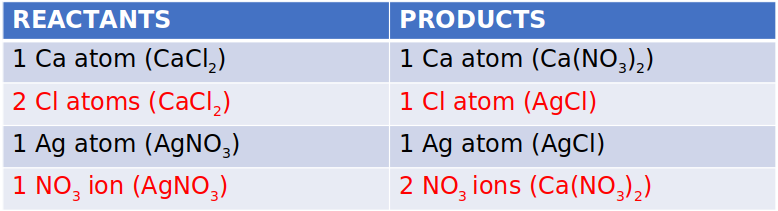 Full Ionic equation
So let’s balance the nitrates
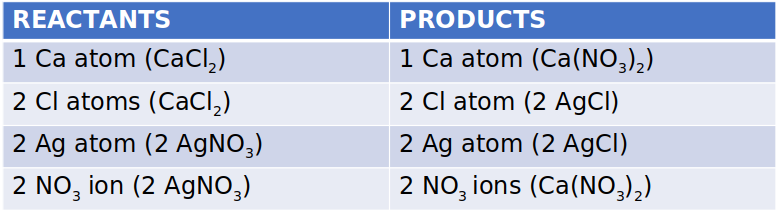
CaCl2(aq) + 2 AgNO3(aq) ➞ Ca(NO3)2(aq) + AgCl(s)
Which now imbalances silver (Ag). Fix that by doubling AgCl…
CaCl2(aq) + 2 AgNO3(aq) ➞ Ca(NO3)2(aq) + 2 AgCl(s)
That resolved the unbalanced Ag and the Cl.
Example Physcial Change Reactions
We sometimes write reactions that don’t quite seem like reactions but rather show physical changes:
Adding heat to ice produces liquid: H2O(s) + Δ ➞ H2O(l)
Dissolving salt in water: NaCl(s) ➞ Na+ (aq) + Cl- (aq)
Sometimes, a chemical reaction can occur where only some of the atoms or ions create products while others remain unchanged. For example, if we mix a solution of CaCl2(aq) with a solution of AgNO3(aq) , the reaction can be written as:
CaCl2(aq) + 2 AgNO3(aq) ➞ 2 AgCl(s) + Ca(NO3)2(aq)
Since several of these reagents are in the aqueous form, the ionic salts are really present as their individual ions in water, and we can expand this to:
Ca2+ (aq) + 2 Cl- (aq) + 2 Ag+(aq) + 2 NO3- (aq) ➞ 2 AgCl(s) + Ca2+ (aq) + 2 NO3- (aq) Full Ionic equation
Note that above, the Ca2+ (aq) and 2 NO3- (aq) appear unchanged on both sides of the reaction. We call these spectator ions, they start on the reactants side paired with other ions which then dissolve. But after the reaction occurs to create AgCl(s), they remain dissolved and unchanged on the products side.
So, the actual chemical reaction of interest here is just
2 Cl- (aq) + 2 Ag+ (aq) ➞ 2 AgCl(s) Net Ionic Equation
The first reaction is the full ionic reaction, while the second is called the net ionic reaction. We can further simplify be removing all of the ‘2’s.
Mixing two aqueous reactants together to form a solid product is called a precipitation reaction. The above example can also be called a double displacement reaction, where the reactant cations and anions switch with one another to form the products.
Final Notes
Any time a reaction occurs where an aqueous component is found on both reactant and product side, unchanged, it can be removed as a spectator ion. But if a new compound is formed in the solid, liquid, or gas phase, it may not be removed.
CaCO3(aq) + 2 HCl(aq) ➞ CaCl2(aq) + CO2(g) + H2O(l)
Ca2+(aq) + CO32-(aq) + 2H+(aq) + 2Cl- (aq) ➞ Ca2+(aq) + 2Cl- (aq) + CO2(g) + H2O(l)
Here, Ca2+(aq) and 2Cl-(aq) are the spectator ions; the net ionic is
CO32-(aq) + 2H+(aq) ➞ CO2(g) + H2O(l)