- 1. Getting Started
-
2.
First Semester Topics
-
General Chemistry Review
- Introduction
- Electron Configurations of Atoms
- QM Description of Orbitals
- Practice Time - Electron Configurations
- Hybridization
- Closer Look at Hybridization
- Strategy to Determine Hybridization
- Practice Time! - Hybridization
- Formal Charge
- Practice Time - Formal Charge
- Acids-bases
- Practice Time - Acids and Bases
- Hydrogen Bonding is a Verb!
-
Structure and Bonding
- Chemical Intuition
- From Quantum Mechanics to the Blackboard: The Power of Approximations
- Atomic Orbitals
- Electron Configurations of Atoms
- Electron Configurations Tutorial
- Practice Time - Structure and Bonding 1
- Lewis Structures
- Drawing Lewis Structures
- Valence Bond Theory
- Valence Bond Theory Tutorial
- Hybridization
- Polar Covalent Bonds
- Formal Charge
- Practice Time - Structure and Bonding 2
- Curved Arrow Notation
- Resonance
- Electrons behave like waves
- MO Theory Intro
- Structural Representations
-
Acids/Base and Reactions
- Reactions
- Reaction Arrows: What do they mean?
- Thermodynamics of Reactions
- Acids Intro
- Practice Time! Generating a conjugate base.
- Lewis Acids and Bases
- pKa Scale
- Practice Time! pKa's
- Predicting Acid-Base Reactions from pKa
- Structure and Acidity
- Structure and Acidity II
- Practice Time! Structure and Acidity
- Curved Arrows and Reactions
- Nucleophiles
- Electrophiles
- Practice Time! Identifying Nucleophiles and Electrophiles
- Mechanisms and Arrow Pushing
- Practice Time! Mechanisms and Reactions
- Energy Diagrams and Reactions
- Practice Time! - Energy Diagrams
- Introduction to Retrosynthesis
-
Alkanes and Cycloalkanes
- Introduction to Hydrocarbons and Alkanes
- Occurrence
- Functional Groups
- Practice Time! Functional Groups.
- Structure of Alkanes - Structure of Methane
- Structure of Alkanes - Structure of Ethane
- Naming Alkanes
- Practice Time! Naming Alkanes
- Alkane Isomers
- Relative Stability of Acyclic Alkanes
- Physical Properties of Alkanes
- Ranking Boiling Point and Solubility of Compounds
- Conformations of Acyclic Alkanes
- Practice Time! Conformations of acyclic alkanes.
- Conformations of Cyclic Alkanes
- Naming Bicyclic Compounds
- Stability of Cycloalkane (Combustion Analysis)
- Degree of Unsaturation
-
Stereochemistry
- Enalapril in ACE
- Constitutional and Stereoisomers
- Chirality or Handedness
- Drawing a Molecules Mirror Image
- Exploring Mirror Image Structures
- Enantiomers
- Drawing Enantiomers
- Practice Time! Drawing Enantiomers
- Identifying Chiral Centers
- Practice Time! Identifying Chiral Molecules
- CIP (Cahn-Ingold-Prelog) Priorities
- Determining R/S Configuration
- Diastereomers
- Meso Compounds
- Fischer Projections
- Fischer Projections: Carbohydrates
- Measuring Chiral Purity
- Practice Time! - Determining Chiral Purity and ee
- Chirality and Drugs
- Chiral Synthesis
- Prochirality
- Converting Fischer Projections to Zig-zag Structures
- Practice Time! - Assigning R/S Configurations
-
Alkenes and Addition Reactions
- The Structure of Alkenes
- Alkene Structure - Ethene
- Physical Properties of Alkenes
- Naming Alkenes
- Health Insight - BVO (Brominated Vegetable Oil)
- E/Z and CIP
- Stability of Alkenes
- H-X Addition to Alkenes: Hydrohalogenation
- Practice Time - Hydrohalogenation
- X2 Addition to Alkenes: Halogenation
- HOX addition: Halohydrins
- Practice Time - Halogenation
- Hydroboration/Oxidation of Alkenes: Hydration
- Practice Time - Hydroboration-Oxidation
- Oxymercuration-Reduction: Hydration
- Practice Time - Oxymercuration/Reduction
- Oxidation and Reduction in Organic Chemistry
- Calculating Oxidation States of Carbon
- Identifying oxidation and reduction reactions
- Practice Time - Oxidation and Reduction in Organic
- Oxidation
- Reduction
- Capsaicin
-
Alkynes
- Structure of Ethyne (Acetylene)
- Naming Alkynes
- Practice Time! - Naming Alkynes
- Physical Properties of Alkynes
- Preparation of Alkynes
- Practice Time! - Preparation of Alkynes
- H-X Addition to Alkynes
- X2 Addition
- Hydration
- Reduction of Alkynes
- Practice Time! - Addition Reactions of Alkynes
- Oxidative Cleavage of Alkynes
- Alkyne Acidity and Acetylide Anions
- Reactions of Acetylide Anions
- Retrosynthesis Revisted
- Practice Time! - Multistep Synthesis Using Acetylides
-
Alkyl Halides and Alcohol
- Naming Alkyl Halides
- Naming Alcohols
- Classes of Alcohols and Alkyl Halides
- Practice Time! - Naming Alkyl Halides
- Practice Time! - Naming Alcohols
- Physical Properties of Alcohols and Alkyl Halides
- Structure and Reactivity of Alcohols
- Structure and Reactivity of Alkyl Halides
- Preparation of Alkyl Halides and Tosylates from Alcohols
- Practice Time! - Alcohols to Alkyl Halides
- Preparation of Alkyl Halides from Alkenes; Allylic Bromination
- Strategy for Predicting Products of Allylic Brominations
- Practice Time! - Allylic Bromination
-
Substitutions (SN1/SN2) and Eliminations (E1/E2)
- Introduction
- Solvents
- SN1 Reaction: The Carbocation Pathway
- SN2 Reactions: The Concerted Backside Attack
- SN1 vs. SN2: Choosing the Right Path
- Application: Cardura (Doxazosin)
- E1 Reactions: Elimination via Carbocations
- E2 Reactions: The Concerted Elimination
- E1cB: The Conjugate Base Elimination Pathway
- Substitution versus Elimination
- Dienes, Allylic and Benzylic systems
-
General Chemistry Review
-
3.
Second Semester Topics
- Arenes and Aromaticity
-
Reactions of Arenes
- Electrophilic Aromatic Substitution
- EAS-Halogenation
- EAS-Nitration
- Practice Time - Synthesis of Aniline
- EAS-Alkylation
- Practice Time - Friedel Crafts Alkylation
- EAS-Acylation
- Practice Time - Synthesis of Alkyl Arenes
- EAS-Sulfonation
- Practice Time - EAS
- Donation and Withdrawal of Electrons
- Regiochemistry in EAS
- Practice Time - Directing Group Effects
- Synthesizing Disubstituted Benzenes: Effects of Substituents on Rate and Orientation
- Steric Considerations
- Strategies for Synthesizing Disubstituted Benzenes
- NAS - Addition/Elimination
- NAS - Elimination/Addition - Benzyne
- Alcohols and Phenols
-
Ethers and Epoxides
- Intro and Occurrence
- Crown Ethers and Cryptands
- Preparation of Ethers
- Reactions of Ethers
- Practice Time - Ethers
- Preparation of Epoxides
- Reactions of Epoxides - Acidic Ring Opening
- Practice Time - Acidic Ring Opening
- Reactions of Epoxides - Nucleophilic Ring Opening
- Practice Time - Nucleophilic Ring opening
- Application - Epoxidation in Reboxetine Synthesis
- Application - Nucleophilic Epoxide Ring Opening in Crixivan Synthesis
- Physical Properties of Ethers and Epoxides
- Naming Ethers and Epoxides
-
Aldehydes and Ketones
- Naming Aldehydes and Ketones
- Physical Properties of Ketones and Aldehydes
- Practice Time - Naming Aldehydes/Ketones
- Nucleophilic addition
- Addition of Water - Gem Diols
- Practice Time - Hydration of Ketones and Aldehydes
- Addition of Alcohols - Hemiacetals and Acetals
- Acetal Protecting Groups
- Hemiacetals in Carbohydrates
- Practice Time - Hemiacetals and Acetals
- Addition of Amines - Imines
- Addition of Amines - Enamines
- Practice Time - Imines and Enamines
- Application - Imatinab Enamine Synthesis
- Addition of CN - Cyanohydrins
- Practice Time - Cyanohydrins
- Application - Isentress Synthesis
- Addition of Ylides - Wittig Reaction
- Practice Time - Wittig Olefination
- Structure of Ketones and Aldehydes
- Carboxylic Acids and Derivatives
- Enols and Enolates
- Condensation Reactions
-
4.
NMR, IR, UV and MS
- Spectroscopy
-
HNMR
- Nuclear Spin
- Interpreting
- Chemical Shift
- Practice Time! - Chemical Shift
- Equivalency
- Indentifying Homotopic, Enantiotopic and Diastereotopic Protons
- Practice Time! - Equivalency
- Intensity of Signals
- Spin Spin Splitting
- Practice Time! - Spin-Spin Splitting
- Primer on ¹³C NMR Spectroscopy
- Alkanes
- Alkynes
- Alcohols
- Alkenes
- Coupling in Cis/Trans Alkenes
- Ketones
- HNMR Practice 1
- HNMR Practice 2
- HNMR Practice 3
- HNMR Practice 4
- Exchangeable Protons and Deuterium Exchange
- IR - Infrared Spectroscopy
- UV - Ultraviolet Spectroscopy
- Mass Spectrometry
-
5.
General Chemistry
- General Chemistry Lab
- Strategy for Balancing Chemical Reactions
- Calculator Tips for Chemistry
- Significant Figures
- Practice Time! Significant Figures
- Spreadsheets - Getting Started
- Spreadsheets - Charts and Trend lines
- Standard Deviation
- Standard Deviation Calculations
- Factor Labels
- Practice Time! - Factor Labels
- Limiting Reagent Problem
- Percent Composition
- Molar Mass Calculation
- Average Atomic Mass
- Empirical Formula
- Practice time! Empirical and Molecular Formulae
- Initial Rate Analysis
- Practice Time! Initial Rate Analysis
- Solving Equilibrium Problems with ICE
- Practice Time! Equilibrium ICE Tables
- Le Chatelier's
- Practice Time! Le Chatelier's Principle
- 6. Organic Chemistry Lab
-
7.
Tools and Reference
- 2D Editor
- 3D Model Kit
- Molar Mass Calculator
- Newman Projection Tool
- Fischer to Zigzag
- Chromatograph Simulator
- TLC Simulator
- Periodic Table
- Sig Fig Calculator
- Degree of Unsaturation Calculator
- Chemical Reaction Kinetic Simulator
-
Reagents
- Named Reactions
- pKa Values
- Heterocycles
- Bond Dissociation Energies
- 8. Tutorials
-
9.
The Alchemy of Drug Development
- Ivermectin: From Merck Innovation to Global Health Impact
- The Fen-Phen Fix: A Weight Loss Dream Turned Heartbreak
- The Asymmetry of Harm: Thalidomide and the Power of Molecular Shape
- Semaglutide (Ozempic): From Lizard Spit to a Once-Weekly Wonder
- From Cocaine to Novocain: The Development of Safer Local Anesthesia
- The Crixivan Saga: A Targeted Strike Against HIV
- The story of Merck’s COX-2 inhibitor, Vioxx (rofecoxib)
- The Accidental Aphrodisiac: The Story of Viagra
- THC: A Double-Edged Sword with Potential Neuroprotective Properties?
- Ritonavir Near Disaster and Polymorphism
- 10. Allied Health Chem
Clear History
Quick Menu
Chemical Nomenclature
In clinical settings, "Sodium Chloride" and "Sodium Chlorite" are two very different substances. It important to understand the difference.
1. Common and Systematic Naming
Many substances are so deeply integrated into our daily routines that we refer to them by familiar "nicknames" or "Common names" much like we do with close friends. A single compound often carries multiple common or trivial names; for instance, the white crystals in your shaker are known as "salt." If you were to ask for it by its more formal name, sodium chloride, at a backyard barbecue, you might get a few puzzled looks.
However, the situation becomes truly absurd if you attempt to use its full systematic name in a casual setting:
"Could you please pass the ionic halite lattice of sodium and chlorine ions?"
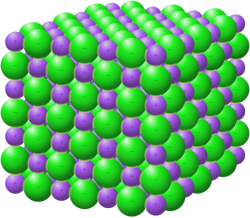
NaCl Lattice Structure
2. Elements
Some elements were not really "discovered", but have been known since ancient times; many of these have symbols that are derived from the Latin names of the elements.
| Element Name | Symbol | Latin Name |
|---|---|---|
| Antimony | Sb | Stibium |
| Copper | Cu | Cuprum |
| Gold | Au | Aurum |
| Iron | Fe | Ferrum |
| Lead | Pb | Plumbum |
| Mercury | Hg | Hydrargyrum |
| Potassium | K | Kalium |
| Sodium | Na | Natrium |
| Tin | Sn | Stannum |
3. Transition Metals (The Roman Numeral Rule)
Because metals like Iron (Fe) or Copper (Cu) can have different charges, we specify the charge in the name:
- FeCl2: Iron (II) chloride (Uses Fe2+)
- FeCl3: Iron (III) chloride (Uses Fe3+)_
| Ion Symbol (Lower Charge) | Ion Symbol (Higher Charge) | Element Name |
|---|---|---|
| Cu+ | Cu2+ | Copper |
| Fe2+ | Fe3+ | Iron |
| Sn2+ | Sn4+ | Tin |
| Pb2+ | Pb4+ | Lead |
| Chemical Symbol | Common (Trivial) Name | Formal (Systematic) Name |
|---|---|---|
| Cu+ | Cuprous ion | Copper(I) ion |
| Cu2+ | Cupric ion | Copper(II) ion |
| Fe2+ | Ferrous ion | Iron(II) ion |
| Fe3+ | Ferric ion | Iron(III) ion |
| Sn2+ | Stannous ion | Tin(II) ion |
| Sn4+ | Stannic ion | Tin(IV) ion |
4. Binary Molecular Compounds (Greek Prefixes)
For nonmetal compounds, use prefixes to show the number of atoms:
| Formula | Prefixes Used | Name |
|---|---|---|
| SO2 | di = 2 | Sulfur dioxide |
| N2O5 | di = 2, penta = 5 | Dinitrogen pentoxide |
_di = 2
tri = 3
tetra = 4
penta = 5
hexa = 6
Examples:
- N2O4 - dinitrogen tetroxide [note the missing a preceding the vowel]
- N2O - dinitrogen oxide [more commonly, nitrous oxide]
- SF6 - sulfur hexafluoride
- P4S3 - tetraphosphorus trisulfide [more commonly, phosphorus sesquisulfide]
- Na2HPO4 - disodium hydrogen phosphate
- H2S - hydrogen sulfide [we skip both the di and mono]
- CO - carbon monoxide [mono- to distinguish it from the dioxide]
- CaSO4·½H2O - calcium sulfate hemihydrate [In this solid, two CaSO4 units share one water of hydration between them; more commonly called Plaster of Paris]
It will be apparent from these examples that chemists are in the habit of taking a few liberties in applying the strict numeric prefixes to the more commonly known substances.
These two-element compounds are usually quite easy to name because most of them follow the systematic rule of adding the suffix -ide to the root name of the second element, which is normally the more "negative" one. Several such examples are shown above. But as noted above, there are some important exceptions in which common or trivial names take precedence over systematic names:
- H2O (water, not dihydrogen oxide)/
- H2O2 (hydrogen peroxide, not dihydrogen dioxide)
- H2S (hydrogen sulfide, not dihydrogen sulfide)
- NH3 (ammonia, not nitrogen trihydride)
- NO (nitric oxide, not nitrogen monoxide)
- N2O (nitrous oxide, not dinitrogen oxide)
- CH4 (methane, not carbon tetrahydride)
3. Clinical Acids to Memorize
These acids are frequently encountered in respiratory therapy and metabolic studies:
- HCl (aq): Hydrochloric acid (Stomach acid)
- H2CO3: Carbonic acid (Formed by CO2 in the blood)
- HNO3: Nitric acid
- H2SO4: Sulfuric acid
4. Hydrates
Some salts can be hydrated, meaning that they have one or more water molecules as part of their crystal structure.
For example, CuSO4∙5H2O is the salt copper (II) sulfate with 5 water molecules attached in the crystal.
The Greek prefix for the number 5 is ‘penta’, so this would be a pentahydrate … copper (II) sulfate pentahydrate.